
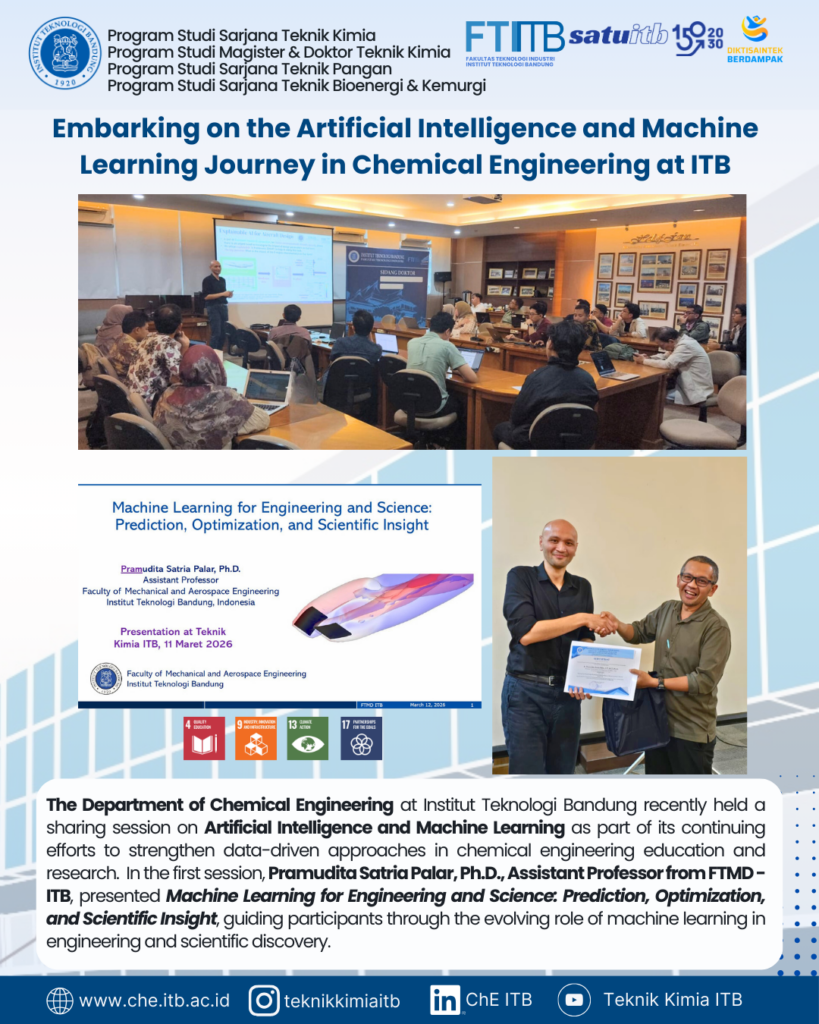
The Department of Chemical Engineering at Institut Teknologi Bandung recently held a sharing session on Artificial Intelligence and Machine Learning as part of its continuing journey to strengthen data-driven approaches in chemical engineering education and research.
The session brought together two experts who shared insights on how AI and machine learning are transforming engineering disciplines and opening new frontiers for scientific discovery.
Pramudita Satria Palar, Ph.D., from the Faculty of Mechanical and Aerospace Engineering, guided participants through the evolving landscape of machine learning in engineering and science. His talk illustrated how machine learning enables prediction, optimization, and discovery from complex datasets. He also presented examples of advanced research conducted by his group and discussed potential directions for applying machine learning to chemical engineering challenges.
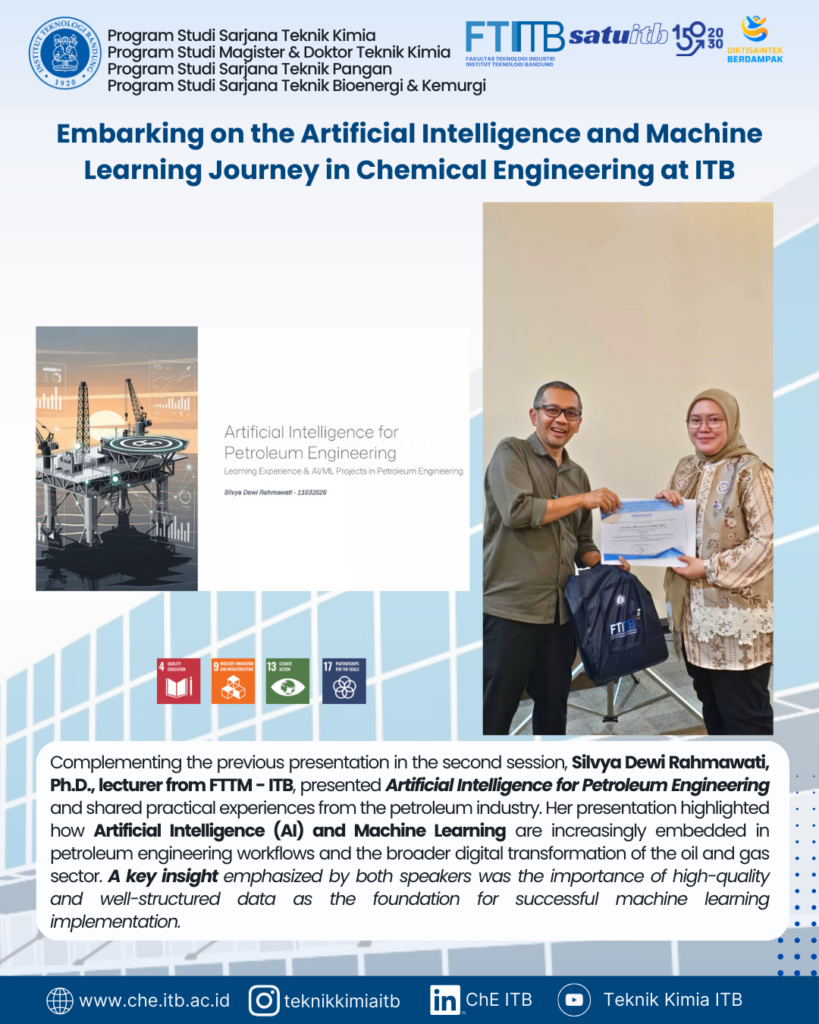
Complementing this perspective, Silvya Dewi Rahmawati, Ph.D., from the Faculty of Mining and Petroleum Engineering, shared practical experiences from the petroleum industry. Her presentation highlighted how AI and machine learning are increasingly embedded in petroleum engineering workflows and the broader digital transformation of the oil and gas sector. She also discussed the opportunities and challenges in adopting AI technologies and shared her experience in developing AI-supported learning environments in teaching and research, including at the undergraduate level.
A key insight emphasized by both speakers was the importance of high-quality and well-structured data as the foundation for successful machine learning implementation.
Beyond technological tools, the discussion also highlighted the growing importance of data literacy, computational thinking, and AI fluency as core professional competencies for future chemical engineers. These capabilities enable engineers to combine deep domain expertise in chemical engineering with the power of intelligent machines, allowing them to address increasingly complex industrial challenges—from process optimization and predictive modeling to sustainable system design.
The session was attended by enthusiastic lecturers and students and concluded with a lively discussion on how the chemical engineering community at ITB can continue this journey toward data-driven innovation in education, research, and future curriculum development.
 English
  Bahasa Indonesia